
A Brand Built Around Compressed Air Performance
For industrial buyers evaluating compressed air equipment, brand selection is not a trivial decision. The compressor at the center of a facility’s air system will run for thousands of hours annually, require periodic maintenance and eventual parts replacement, and be the single point of failure if performance drops at the wrong moment. The supplier behind that equipment needs to have the technical depth, parts support, and service infrastructure to back up what they sell.
That’s the context in which pneutech has built its position in the industrial compressed air market. Rather than competing across every category with generalist offerings, the brand has developed a focused portfolio centered on the compressor technologies that industrial buyers actually need — backed by product engineering that prioritizes reliability, efficiency, and long-term serviceability. This article explores the key product lines that define PneuTech’s offering and the reasons industrial operations are choosing them for new installations and fleet replacements.
Reciprocating Technology: Performance Where It Counts
Within the PneuTech product portfolio, the reciprocating air compressor lineup addresses applications where the piston-and-cylinder design’s inherent characteristics — high-pressure capability, intermittent-duty tolerance, and mechanical robustness — make it the technically appropriate choice rather than a compromise.
Industrial reciprocating compressors are built for demanding environments. The compression mechanism generates heat and mechanical stress that requires quality materials and precision engineering to manage reliably across a long service life. PneuTech’s reciprocating designs reflect this requirement in their valve construction, cylinder metallurgy, cooling arrangements, and bearing specifications — details that determine whether a unit delivers a decade of reliable service or begins generating maintenance costs within the first few years.
Key applications served by the reciprocating lineup include automotive service facilities requiring high-pressure output for tire inflation and air tools, manufacturing operations running sandblasting or abrasive processes, workshops and job shops with intermittent demand that don’t require continuous air production, and industrial processes where specific pressure profiles above the optimal range of rotary screw technology are needed. For each of these scenarios, the reciprocating design is not a compromise — it’s the correct tool for the application.
VSD Rotary Screw: Designed for the Modern Industrial Demand Profile
The growth of variable speed drive technology in industrial compressed air has been driven by one overriding reality: most production facilities do not consume compressed air at a constant rate. Shift changes, production scheduling, seasonal variation, and process sequencing all create demand profiles that fluctuate — sometimes dramatically — across the operating day. The variable speed rotary screw air compressor is purpose-built for exactly this environment.
PneuTech’s VSD rotary screw range pairs high-efficiency airend designs with precision drive electronics that continuously modulate motor speed in response to system pressure feedback. The result is a compressor that always produces exactly the volume of air the system requires — no more, no less — without the energy waste of unloading cycles, blow-off valves, or idle running that characterize fixed-speed alternatives under partial-load conditions.
The efficiency gains from VSD operation are most pronounced in facilities where demand regularly drops below 70 to 80 percent of compressor capacity — which describes the majority of manufacturing, processing, and service environments where production schedules create predictable low-demand windows. Independent assessments of VSD installations consistently document 35 to 50 percent reductions in compressor energy consumption compared to fixed-speed predecessors of equivalent rated capacity.
System Integration: Beyond the Compressor
A compressor is the starting point of a compressed air system, not the complete solution. The efficiency and reliability of the air delivered at the point of use depends on how well the compressor is integrated with downstream system components — and a supplier’s capability in this area is often what separates a good installation from a great one.
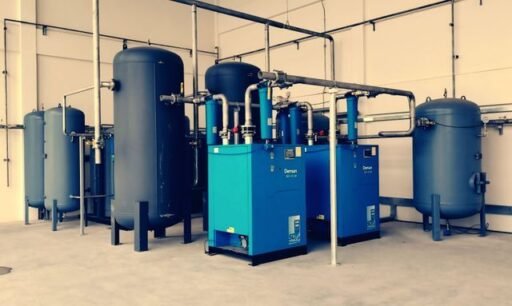
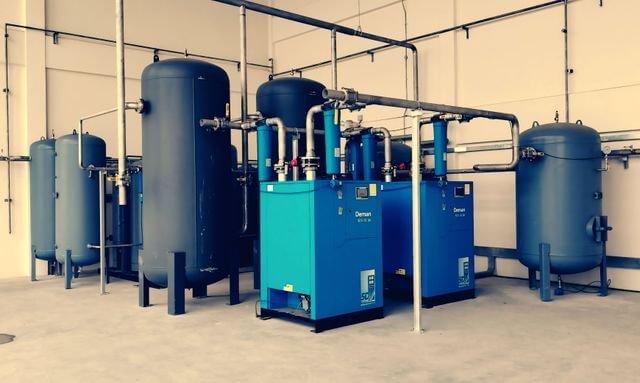
Effective system design encompasses receiver tank sizing and placement to buffer demand peaks and protect against pressure fluctuations, refrigerated and desiccant dryer selection appropriate to the dew point requirements of the application, filtration stages matched to the air quality sensitivity of the downstream processes, and piping layout and diameter that minimize pressure drop between the compressor room and points of use. Each of these elements interacts with the others, and getting them right requires experience with real-world system behavior rather than theoretical design.
Buyers who engage with PneuTech not just for equipment selection but for system design support gain access to this integrated expertise — a resource that pays dividends in system performance, energy efficiency, and long-term reliability beyond what equipment specification alone can achieve.
Service Infrastructure and Long-Term Support
The value of compressed air equipment is realized over its operational life, not at the moment of purchase. A compressor that runs for 12,000 to 15,000 hours annually will require scheduled preventive maintenance, periodic component replacement, and occasional unplanned service attention over a decade of operation. The service infrastructure behind the equipment brand is what determines whether those interventions are quick and straightforward or protracted and expensive.
Parts availability is the most practical indicator of a supplier’s service capability. OEM components designed and manufactured to the original specifications maintain the performance envelope the compressor was designed around; aftermarket substitutes frequently introduce subtle compromises that accumulate into reliability problems over time. Response time commitments, remote diagnostic capability, and technical support depth are additional dimensions worth evaluating before committing to a supplier relationship that will extend for years.
Conclusion
Industrial buyers evaluating compressed air equipment are making a decision with a 10 to 15-year time horizon. The brand behind the equipment, the depth of the product engineering, the quality of system integration support, and the reliability of long-term service infrastructure all contribute to outcomes over that period. PneuTech’s focused approach to the compressed air market — delivering technically appropriate solutions across the reciprocating and rotary screw categories backed by genuine application expertise — is the foundation on which that confidence is built.