

Modern marketing has become exceptionally efficient at targeting audiences, but efficiency has come with a cost. Consumers now move through a media environment saturated with polished ads, algorithmic recommendations, sponsored posts, and promotional emails that blur together by the end of the day. In that setting, attention is no longer the only scarce resource. Memory is scarce too. A campaign may generate impressions at scale, yet still fail to leave a distinct impression on the people who matter most.
That reality has helped push experiential marketing from a niche tactic into a central strategic tool for brands that want to be felt, not just seen. Live activations give companies a chance to create a moment that is physical, social, and participatory all at once. Instead of asking an audience to passively absorb a message, the brand invites people to enter a scene and take part in it. The result is often more durable than a digital view because it is tied to movement, emotion, and interaction.
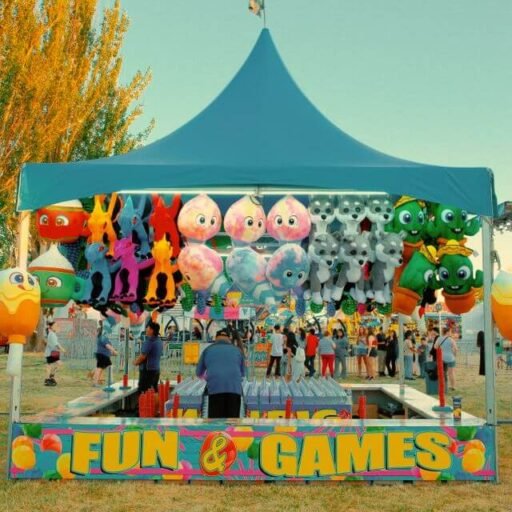
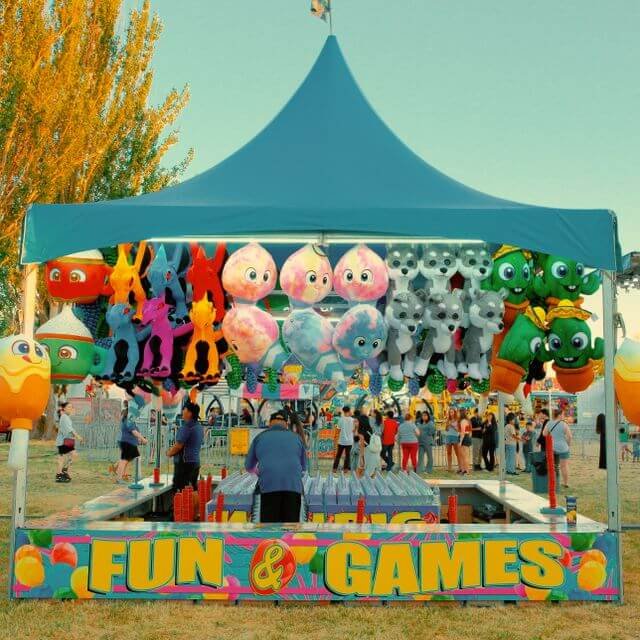
Branded carnival games sit squarely within that shift. They combine the familiarity of classic midway entertainment with the modern demands of brand storytelling, event design, and social sharing. A game provides structure, but also surprise. It creates anticipation before the play begins, tension while the challenge unfolds, and release when the player wins or loses. Those emotional beats give marketers something increasingly valuable, which is a brand moment people actually want to talk about afterward.
The Rise of Play as a Serious Marketing Tool
Play has become one of the most effective ways for brands to reduce the distance between themselves and their audiences. In crowded public settings, people rarely stop for static signage alone unless they already have a strong reason to care. What consistently changes that equation is movement, curiosity, and the visible presence of other people having a good time. A game creates all three at once. It gives bystanders something immediate to understand, while also suggesting that the brand behind it may be worth a closer look.
This is one reason experiential marketers have leaned more heavily into interactive formats over the past decade. A well-built game does more than entertain for a few minutes. It can pull visitors into a booth, extend dwell time, create a natural opening for product education, and give guests a story to retell once the event is over. The strongest concepts also make room for spectatorship, which is often just as valuable as direct participation. When a crowd gathers around a branded challenge, the activation begins working on multiple levels at once, drawing players, onlookers, and potential customers into the same orbit.
As brands have leaned further into interactive experiences, many have turned to specialist partners that know how to turn play into a polished marketing tool. Companies such as Something New have built a reputation at the intersection of design, entertainment, and strategy, particularly through live activations that make audience participation feel natural rather than forced. That approach is especially evident in the use of custom games, where the familiar appeal of carnival play is reworked into something tailored, branded, and event-ready. The larger point is that branded play is no longer a novelty at live events. It has become a deliberate way for companies to make brand experiences more memorable, social, and effective.
From Midway Attraction to Brand Platform
Traditional carnival games were designed around spectacle, simplicity, and repetition. A passerby could understand the challenge almost instantly, whether it involved knocking down targets, landing a ring, tossing a ball, or testing reflexes under pressure. That clarity remains central to their marketing value today. In a crowded event environment, brands need experiences that can be understood at a glance and joined without lengthy explanation. Carnival formats excel because they offer exactly that kind of immediate accessibility.
What has changed is the strategic role the game now plays. In the past, the game itself was the attraction and the prize was the reward. In branded experiences, the game becomes a platform for communicating identity, category, and point of view. A consumer electronics company might turn a timing challenge into a demonstration of speed and precision. A beverage brand might build a toss game around flavor discovery and social competition. A financial services firm might use a game to humanize an otherwise abstract offering by making problem solving visible and enjoyable.
This evolution has turned the carnival game into an unusually flexible storytelling device. It can be whimsical, premium, loud, elegant, kinetic, or theatrical depending on the audience and venue. The structure is simple, but the creative possibilities are broad. That matters because experiential marketing now spans product launches, corporate events, festivals, retail pop-ups, trade shows, recruiting initiatives, and internal culture programs. In each case, the game can be adapted to support a distinct objective while preserving the same core strength, which is fast engagement through playful participation.
The Psychology Behind Branded Game Experiences
The success of branded carnival games is rooted in basic human behavior. Games create stakes, even when the stakes are small. They invite people to test themselves in public, compare performance with friends, and experience a compact burst of suspense. That combination activates attention in a way that many brand interactions do not. People lean in because they want to see what happens next, and that anticipation makes the experience easier to remember later.
There is also a social dimension that marketers often underestimate. A game does not engage only the participant. It engages the audience standing nearby, the colleague recording the attempt, the friend cheering from the side, and the stranger who decides to take a turn after watching someone else play. One activation can therefore produce multiple levels of participation at once. Some people compete, others spectate, and others document the moment for social sharing. The brand benefits from all three forms of involvement.
Memory formation is another powerful advantage. When individuals do something with their hands, make a decision under pressure, and experience an emotional outcome, the moment tends to embed more deeply than a passive interaction. That is especially true when the experience has a narrative arc, such as challenge, attempt, result, and reward. A successful branded game taps into that sequence with precision. It gives the audience a story they can instantly retell, and in that retelling the brand often remains central.
Designing Carnival Games That Serve the Brand
Not every branded game works equally well, and the difference usually comes down to design discipline. The strongest executions begin with a clear strategic question. What should the attendee understand, feel, or do after playing? If the answer is vague, the game will likely be vague too. A carnival concept may attract attention on its own, but attention without alignment does little for brand equity. The best work starts by identifying the business objective and then building the experience backward from that goal.
From there, the physical design has to support both usability and storytelling. The challenge must be legible from a distance and intuitive up close. Visual branding needs to be integrated rather than simply pasted onto surfaces. Colors, materials, copy, staffing, prize design, and surrounding scenic elements should all reinforce the same message. If the game feels disconnected from the broader activation, it risks becoming entertainment for entertainment’s sake. That can still be fun, but it is less effective as marketing.
Good design also respects the rhythm of live events. A game that takes too long to explain or complete can create frustrating lines and reduce throughput. A game that is too easy may feel trivial, while one that is too hard may discourage participation. The sweet spot lies in making the experience achievable enough to invite broad involvement, but challenging enough to create drama. When marketers get that balance right, the activation feels generous rather than transactional. People leave with the sense that the brand invested in giving them a real experience, not just a logo-covered distraction.
Measuring More Than Foot Traffic
Experiential marketing has matured in part because brands have become more rigorous about measurement. In earlier eras, live activations were sometimes judged by atmosphere alone. A crowd gathered, photos were taken, and the event was deemed a success. Today, clients expect more. They want to know how many people participated, how long they stayed, what content was created, what leads were generated, what products were sampled, and how the experience contributed to broader campaign goals.
Branded carnival games are especially well suited to this more disciplined environment because they naturally produce measurable behaviors. Participation counts are straightforward. Repeat plays can be tracked. Prize redemption can offer another data point. Staff interactions before or after gameplay can be tied to lead capture, product education, or retail conversion. Even observational metrics, such as dwell time and crowd formation, can help indicate whether the experience is functioning as intended. The game offers a visible unit of engagement, which makes performance easier to assess.
Still, the smartest marketers understand that not everything important fits neatly into a dashboard. The intangible effects of an activation, including sentiment, distinctiveness, and emotional resonance, often matter as much as raw totals. A branded game that generates fewer plays than expected may still succeed if it produces exceptional content, premium perception, or strong executive visibility at a key event. Measurement should therefore be broad enough to capture both efficiency and impact. The goal is not simply to count interactions, but to understand whether those interactions strengthened the brand in a meaningful way.
Why Branded Games Fit the Future of Experiential Marketing
Experiential marketing is moving toward formats that are modular, mobile, and highly adaptable across settings. Brands want concepts that can travel from a conference floor to a retail footprint, from a music festival to a company headquarters, without losing their essential identity. Branded carnival games answer that need well. They can be scaled up into immersive installations or scaled down into compact activations. They can anchor a larger event or serve as a single memorable touchpoint within one.
The format also aligns with a broader consumer preference for experiences that feel participatory instead of promotional. Audiences are increasingly adept at detecting when a brand is trying too hard to manufacture relevance. By contrast, play offers a more honest contract. It says that the brand is offering a challenge, a laugh, a reward, or a moment of surprise. That exchange feels transparent, and transparency matters. Consumers tend to respond more warmly when they feel they are being invited into an experience rather than managed through a message.
Looking ahead, the most effective experiential campaigns are likely to combine tactile design with strong strategic clarity. Technology will continue to play an important role, whether through data capture, dynamic scoring, personalized follow-up, or digital amplification. Yet the underlying principle will remain surprisingly old-fashioned. People remember what they do, what they feel, and what they share with others. Branded carnival games endure because they operate at the intersection of all three. In a marketplace crowded with polished claims and fleeting impressions, that makes them not a novelty, but a serious instrument of modern brand building.


